How to Prove True Informed Consent in the Age of Telehealth Consent
What does informed consent look like in a telehealth consent workflow?
Let's walk you through a concrete example:
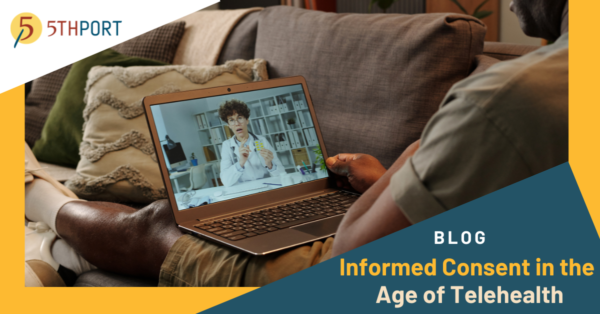
A clinician explains a procedure to a patient during a telehealth appointment.
The risks are discussed. The benefits are reviewed. Questions are answered. Consent is documented.
The process may look similar to an in-person encounter, but something important has changed.
In a virtual setting, it can be harder to gauge understanding. Clinicians have fewer cues to work with. Conversations may be shorter. Educational materials are often reviewed before or after the appointment, outside the clinician encounter altogether.
As telehealth consent becomes a permanent part of healthcare delivery, that creates a new challenge.
How do healthcare organizations know whether patients truly understood the information they were given?
The scale of the shift is significant. Medicare telehealth visits increased 63-fold during the pandemic, and telehealth remains a persistent part of healthcare delivery years later. Recent studies continue to show that roughly 20% to 39% of adults engage in telemedicine encounters annually, even after in-person care returned.
At the same time, healthcare researchers and regulators have become increasingly focused on a different problem: comprehension.
Research consistently shows that many patients struggle to fully understand informed consent materials, and studies have found that interactive approaches—including teach-back and test-feedback methods—perform better than passive information delivery alone.
The challenge isn't that healthcare organizations aren't providing information.
It's that they're increasingly being asked to prove that patients understood it.
Patient Understanding Is The New Audit Trail.
The question is shifting from:
"Did we provide the information?"
to:
"Can we demonstrate that the patient engaged with and understood it?"
That shift creates an opportunity to rethink patient education and telehealth consent as a continuous process rather than a single event.
Imagine a patient receiving educational content before a visit, reviewing it in a format that works best for them, completing a brief teach-back exercise, and arriving at their appointment with a clinician who already understands what was reviewed and where questions remain.
Suddenly, informed consent becomes measurable.
Organizations can see content completion rates, engagement patterns, comprehension scores, and teach-back results. They can standardize explanations across providers while creating a digital record of how education was delivered and understood.
It's about creating better visibility into one of the most important parts of care: communication.
And from a compliance and risk perspective, that visibility matters. As healthcare becomes more digital, organizations will increasingly need evidence that education occurred, that patients engaged with it, and that understanding was validated—not simply assumed.
The healthcare organizations that lead in the next decade won't think of informed consent as a form that gets signed. They'll think of it as a communication process that can be measured, improved, and demonstrated.
That's where platforms like 5thPort fit. By combining asynchronous education, standardized content, teach-back workflows, multilingual delivery, and engagement analytics, healthcare organizations can move beyond documenting telehealth consent and start demonstrating telehealth understanding.
Because in the age of telehealth, the strongest proof of informed consent may no longer be a signature.
It may be evidence that the patient truly understood.
—
If you'd like to continue the conversation, email us at info@5thport.com or fill out our contact form. We look forward to hearing from you.