The Future of Patient Decision Aids Is Continuous, Not Episodic
Most patient decision aids are still built around the assumption that patient decision-making happens in a single moment.
But in reality, patients do not walk out of a consultation with perfect understanding, complete clarity, and a finalized decision. They walk out overwhelmed. They go home and talk to spouses, children, and friends. They search online. They watch videos. They revisit materials days later. They forget details. They develop new questions. Sometimes they become more confident. Sometimes even more uncertain.
The decision-making process continues long after the visit ends.
And yet, many patient engagement tactics such as single sheet brochures, a video link to watch, leaflets of forms etc – still operate as though delivering information once is enough.
That’s the gap.
Patients Do Not All Engage the Same Way
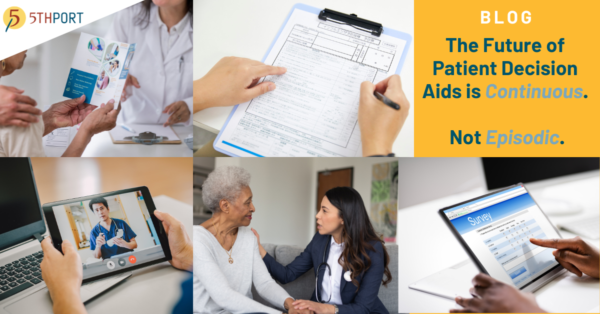
Patient education is not identical for everyone –they learn at their own pace, and have their own “delivery” – some patients want printed brochures they can physically annotate and bring home to family members. Others prefer short videos they can watch multiple times. Some patients want a text message reminder with a link they can revisit later. Others may only engage during in-person interactions.
Importantly also, these preferences are not static. A patient may want one format before a visit and a completely different format afterward.
Meeting patients where they are means more than simply “offering digital access.” It means recognizing that different patients absorb information differently, revisit information differently, and make decisions differently.
Therefore, Shared-Decision Making Is Anything BUT Episodic
This is especially true in chronic disease management, oncology, orthopedics, women’s health, and behavioral health, where decisions evolve over time and patients continuously reassess options, risks, and outcomes.
A patient considering knee replacement surgery, for example, may initially feel ready during the consultation. But two days later, after speaking with family or reading online experiences, entirely new concerns may emerge:
- Recovery timelines
- Financial implications
- Pain management
- Long-term mobility
- Alternatives to surgery
A static PDF or a one-time educational session cannot support that kind of evolving decision journey. Continuous and timely decision support like the following is extremely effective:
- Educational content delivered before the visit
- Follow-up materials personalized to the patient’s concerns afterward
- Videos for patients who prefer visual learning
- Printable summaries for caregivers
- Short surveys identifying unresolved concerns
- Reinforcement content triggered when confusion or hesitation appears
Delivering Information Is Not The Same As Creating Understanding
Healthcare organizations often measure whether educational materials were distributed. But distribution alone tells us very little about comprehension.
A patient opening a brochure does not mean the patient understands their treatment options.
Continuous decision support requires feedback loops.
At 5thPort, our delivery mechanism ensures that doctors and providers gain a concrete understanding of:
- Which materials patients actually engage with
- Which formats are most effective
- Where patients disengage
- What concepts remain unclear
- Whether patients feel confident moving forward
This is where 5thPort’s teach-back methodologies become incredibly important, too.
Short quizzes, pulse surveys, comprehension checks, and feedback prompts through 5thPort can help healthcare organizations move beyond passive education and toward measurable understanding.
Let’s go back to the knee surgery example to illustrate this in real life: If a patient repeatedly struggles to understand the surgical risks, that should inform how the care team follows up. If certain videos consistently improve comprehension more than written materials, the system should learn from that. If patients stop engaging at certain points in the journey, that friction matters.
Continuous engagement means continuous learning — for both patients and providers.
The Future of Patient Decision Aids is Adaptive
The future is about creating adaptive systems that:
- supports patients longitudinally,
- reinforces understanding over time,
- adjusts to patient preferences,
- and helps clinicians identify where additional support is needed.
We truly believe that the organizations that succeed here will not necessarily be the ones with the most educational materials. They will be the ones that create the clearest, most responsive, and most human-centered engagement experiences that are also measurable.
If you’d like to continue the conversation, email us at info@5thport.com or fill out our contact form. We look forward to hearing from you.