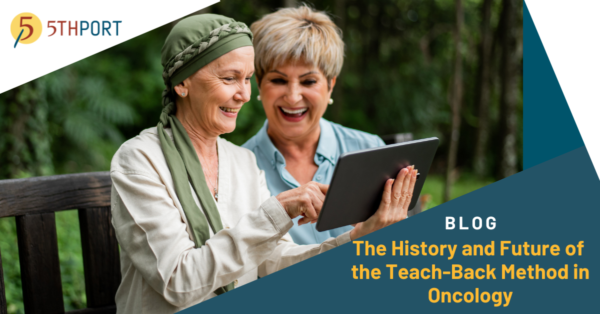
The History and Future of the Teach-Back Method in Oncology
Overview
The teach-back method is a communication technique used to confirm patient understanding by asking individuals to explain information in their own words. It improves comprehension, treatment adherence, and patient safety, and is increasingly supported by digital and AI-enabled education tools.
What Is The Teach-Back Method in Oncology?
The teach-back method is a patient communication approach where individuals are asked to restate medical information in their own words to confirm understanding. In oncology, it is used to ensure patients and caregivers understand diagnoses, treatment plans, side effects, and follow-up instructions.
Use Case: Confirming Patient Understanding in Complex Cancer Care
The teach-back method helps clinicians verify that patients understand critical oncology information, reducing miscommunication during high-stakes treatment decisions.
If you’ve had the unfortunate reality of sitting in a doctor’s office, nodding while your mind spins through new words like “radiation fraction,” “lymph nodes,” or “target volume,” you know how quickly understanding can slip away in moments of fear… Did you know that over half of Americans have either faced cancer themselves, or watched someone they love fight it?
In the field of oncology, this is every day. Patients sit quietly, listening to literally wave after wave of information – diagnosis, treatment, side effects, next steps, remission, recurrence rates, survivorship – while clinicians do their best to explain, reassure, and prepare. Yet studies show that more than half of patients leave these conversations without fully understanding what was said. It isn’t anyone’s fault. It’s just a situational fact.
Let’s start at the very beginning… a very good place to start.
In the 1990s, as “health literacy” entered medical vocabulary, clinicians started realizing that patients weren’t confused because they weren’t listening; they were confused because medicine was speaking in a different language.
So instead of asking, “Do you understand?”, some clinicians began asking, “Just so I know I explained this clearly, can you tell me in your own words what you’ll do when you get home?”
It was a quiet shift. One that caught the attention of the Agency for Healthcare Research and Quality (AHRQ), as well as, the Institute for Healthcare Improvement (IHI) in the early 2000s who formalized it as a best practice. This slight change in communication quickly spread through hospitals and discharge procedures, where patients were suddenly remembering more, adhering better, and returning to hospitals less often with complications.
Over the years, the evidence has spoken clearly and loudly. A 2020 review found teach-back to be effective in 95% of the studies examined – spanning knowledge recall, self-care behaviors and even hospital readmissions. Chronic-care programs show fewer readmissions and higher satisfaction when teach-back is used; in one meta-analysis the readmission rate dropped from 13.5% to 9.1% among patients receiving better discharge communication. Clinicians discovered that those few extra minutes saved hours of confusion later.
And as medicine grew more complex such as new therapies, new technologies, and new patient expectations, teach-back evolved from a communication technique into a safety practice.
Why Clear Communication Matters in Oncology
Cancer care is layered, emotional, and deeply personal. Clear communication is important for several reasons:
- Cancer care involves complex terminology and emotionally charged decisions
- Patients and caregivers are often overwhelmed during clinical visits
- Misunderstanding can lead to poor adherence and safety risks
Radiation schedules. Skin-care precautions. Bloodwork instructions. Consent forms filled with words no one uses outside a hospital. The list is endless.
Impact of the Teach-Back Method on Oncology Outcomes
In general, studies in oncology education have shown that teach-back:
- Improves patient comprehension and recall
- Supports informed consent and shared decision-making
- Reduces errors related to medication and follow-up care
- Strengthens trust between patients and care teams
Chemotherapy education and post-surgical care education studies in particular, have shown that teach-back strengthens comprehension and confidence. In one randomized trial of chemotherapy patients, those who received teach-back education reported fewer symptoms and a slower decline in quality of life (Gucuyener et al., 2025). A broader review also found improvements in self-efficacy, symptom experience, and health literacy among cancer patients (Choi et al., 2021). Nurses report fewer follow-up calls because patients understand what to expect, and perhaps most importantly, patients describe feeling heard.
This is crucial because teach-back isn’t just about understanding; it is about the human connection.
Scaling Teach-Back Through AI-Supported and Digital Education
Digital tools and AI-powered education help extend the teach-back method beyond in-person visits by reinforcing understanding through personalized, repeatable content.
Platforms like 5thPort have taken teach-back and given it scale, structure, and analytics.
Patients now receive personalized digital engagements featuring AI-powered avatars of their own physicians’ likeness, explaining treatment options, risks, and recovery in clear, conversational language.
After each video, short teach-back quizzes measure comprehension instantly. The data flows to clinicians, highlighting who’s prepared, who’s unsure, and what specifically requires more education or examples.
Hospitals and Oncologists using 5thPort have reported:
- 15–20 minutes saved per consult
- Improved patient satisfaction and teach-back performance
- Higher engagement across multilingual, mobile, and hybrid care settings
It’s a continuous learning loop that travels with the patient, wherever they are.
Keeping teach-back front and center in Oncology…
For Oncology teams, the challenge isn’t believing in teach-back but about remembering to use it amid packed schedules, documentation, and the emotional weight of patient care.
Here’s how successful Oncology departments ensure teach-back remains at the front of every clinician’s mind:
1. Build it into the checklist
Make teach-back a formal step in patient education templates, discharge forms, or electronic consent workflows. When it’s a documented field versus a mental picture, you can be sure it’s going to get done.
2. Use triggers in the workflow
Radiation therapists and nurses can use small cues (for eg, before simulation, before first fraction, before discharge) to prompt a teach-back check.
3. Reflect it in performance discussions
Some oncology teams review teach-back notes or digital engagement data during staff meetings or case reviews. Seeing patient comprehension metrics reinforces that clarity is part of quality, not just courtesy.
4. Let technology do the reminding
With platforms like 5thPort, AI-Avatar videos, comprehension quizzes, multilingual education modules, and patient-feedback surveys come together in one loop. Each interaction becomes a data point of understanding – showing who’s ready for treatment, who’s uncertain, and where additional support is needed.
Instead of relying on memory or post-visit notes, clinicians see comprehension trends directly in their dashboards. When education gaps surface, they’re addressed proactively, not reactively. That means fewer follow-up calls, better-prepared patients, and a team that’s always working with clarity, not assumption.
Teach-back is having its ‘full circle moment’
The teach-back method is increasingly recognized as a foundational best practice for effective communication in modern oncology care.
Teach-back has come full circle from a compassionate bedside conversation to a structured, measurable framework that defines modern patient education AND compassion.
With digital tools like 5thPort, this immense responsibility is easier to fulfill – built directly into the workflows, checklists, and engagement data that power every department.