How To Evaluate the Impact of Medical Videos for Patients
Summary: Evaluating the Impact of Medical Videos for Patients
The most effective ways to evaluate medical videos include engagement metrics, comprehension checks, patient feedback, and behavior change.
Video completion rate alone is insufficient; understanding and action matter more than views.
Healthcare teams should combine quantitative analytics with teach-back and outcome-based measures.
Platforms like 5thPort enable closed-loop patient education measurement at scale.
Introduction
This is the sixth installment in our series on the power of medical videos for patients, and multimedia tools in patient engagement. So far, we’ve explored how interactive content and customized videos transform patient education.
Now, let’s tackle an equally important question:
How do you know if it’s actually working?
Creating great educational content is just the first step. To truly improve patient experiences and support clinical teams, we need to track the impact of medical videos for patients and multimedia tools in real time. Here’s how leading healthcare organizations are doing just that.
How do you evaluate the impact of medical videos on patients?
The impact of medical videos is best evaluated by looking at how patients engage with them, how well they understand the information, what feedback they provide, and whether the videos influence their behavior. Effective patient education videos help patients feel more informed and confident, reduce anxiety, support informed consent, and can lead to real improvements such as fewer follow-up questions or better adherence to care instructions.
| Metric Category | What It Measures/Could Measure | Why It Matters |
|---|---|---|
| Engagement | Watch time, completion rate | Indicates relevance and clarity |
| Comprehension | Quiz results, teach-back | Confirms understanding |
| Patient Feedback | Surveys, confidence ratings | Identifies confusion or anxiety |
| Behavior Change | Preparation, adherence | Shows real-world impact |
| Clinical Outcomes | Anxiety reduction, satisfaction | Connects education to care quality |
1. Engagement Rates
Are patients watching the videos all the way through? How much time are they spending with your content? High engagement often means stronger comprehension and better preparation.
With platforms like 5thPort, you can automatically track clicks, time spent, and completions. And if patients are rewatching or spending longer than expected on a video, that signals something too—possibly a more complex topic, language mismatch, or comprehension issue. That insight allows you to respond quickly and adjust accordingly.
In fact, recent research by the National Institute of Health (NIH) shows that visual interventions like medical videos for patients significantly outperform traditional methods in improving health literacy, with one meta-analysis reporting a large effect size favoring video-based education.
Other additional studies confirm that medical videos for patients that are watched before a procedure, report lower anxiety levels and greater satisfaction with care.
2. Patient Feedback
Asking patients what they think—right after they've watched a video—is one of the simplest and most effective ways to improve your content. Was the video clear? Was anything confusing?
But even better: With digital engagement tools like 5thPort, patients can ask questions directly within the content of their eConsent forms. These notes get routed back to the provider in real time, creating a powerful loop of communication and continuous improvement. This is especially important when delivering medical videos for patients covering complex procedures or risks.
3. Comprehension Scores
Engagement is great. But do patients really understand what they just watched?
Medical videos for patients embedded with short quizzes, knowledge checks, or teach-back questions offer valuable, measurable insight. A study published in Cancer found that comprehension of key medical terms significantly increased after patients viewed an educational video—for example, understanding of "incontinence" rose from 14% to 50%, and "impotence" from 58% to 84%.
You'll know if a patient is retaining key information—and where you might need to reinforce certain concepts.
Why 5thPort Stands Out
5thPort is unique in the market in that it takes this a step further with built-in teach-back scoring, giving providers a clear picture of each patient's true comprehension. These scores help identify whether critical information has been absorbed—and if not, where additional support is needed. It's an essential tool for turning passive viewing into active understanding of even the most complex medical videos for patients.
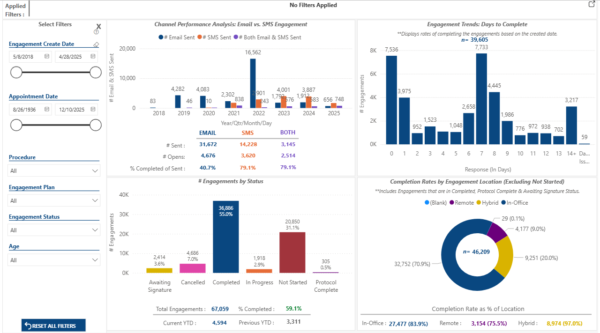
5thPort's Patient Engagement Dashboard
Multimedia education platforms have been shown to improve comprehension and reduce anxiety, especially in complex care spaces. (ScienceDirect)
5thPort doesn't just deliver healthcare videos—it measures their effectiveness automatically. With built-in tracking, you can:
- See who finished which video
- Track quiz results to assess understanding
- Collect patient feedback instantly
- Change, replace or remove medical videos for patients that haven't been well-received
And because everything is integrated into a single platform, your team can make data-informed decisions without extra work or switching between tools.
Healthcare is moving fast. Guesswork doesn't cut it anymore.
If you want to truly support your patients—and your staff—you need to measure what's working, learn from it, and keep improving.
Healthcare Use Cases for Measuring Patient Video Effectiveness
Measuring the effectiveness of patient education videos is especially valuable in care scenarios where understanding, preparedness, and follow-through directly impact outcomes. Common use cases include:
Oncology treatment education and consent
Helping patients understand diagnoses, treatment options, side effects, and care plans, while supporting informed consent and reducing anxiety during complex decision-making.Pre-procedure surgical preparation
Preparing patients for upcoming procedures by explaining what to expect before, during, and after surgery, which can improve readiness, reduce last-minute cancellations, and lower pre-procedure anxiety.Medication and medical device onboarding
Educating patients on how to correctly use medications or medical devices, including dosing, administration, and safety considerations, to improve adherence and reduce errors.Chronic condition self-management
Supporting patients in managing long-term conditions by reinforcing care instructions, lifestyle recommendations, and symptom monitoring over time.Caregiver education and support
Providing caregivers with clear, accessible information so they feel confident supporting patients at home, particularly after discharge or during ongoing treatment.
Ready to reimagine what Patient Education should look like?
Healthcare organizations are increasingly relying on integrated patient education platforms with videos, to measure comprehension, engagement, and outcomes.
Schedule a 5thPort demo today and explore how medical videos for patients can transform how well patients learn about their own health.